
David Bowie
The chameleon of rock
Origins and Early Years
David Robert Jones was born on January 8, 1947 in Brixton, London. He changed his name to David Bowie to avoid confusion with Davy Jones of the Monkees. Marked by a teenage fight that left his left pupil permanently dilated (giving the appearance of differently colored eyes), he studied mime with Lindsay Kemp and developed a strong sense of theatrical performance.
His first major success came with “Space Oddity” in 1969, released five days before the Apollo 11 moon landing. The character Major Tom, an astronaut lost in space, marked the beginning of a career built around successive alter egos.
Ziggy Stardust and the Glam Era
The album The Rise and Fall of Ziggy Stardust and the Spiders from Mars (1972) made him a glam rock icon. His ability to reinvent himself – Ziggy Stardust (alien rock star), Aladdin Sane, Halloween Jack, The Thin White Duke – revolutionized the image of the rock star and blurred the boundaries of gender and sexuality.
His Berlin-era collaboration with Brian Eno produced the trilogy Low (1977), “Heroes” (1977), and Lodger (1979), three albums that fused rock, ambient, and electronic music, directly influencing new wave, post-punk, and synthpop.
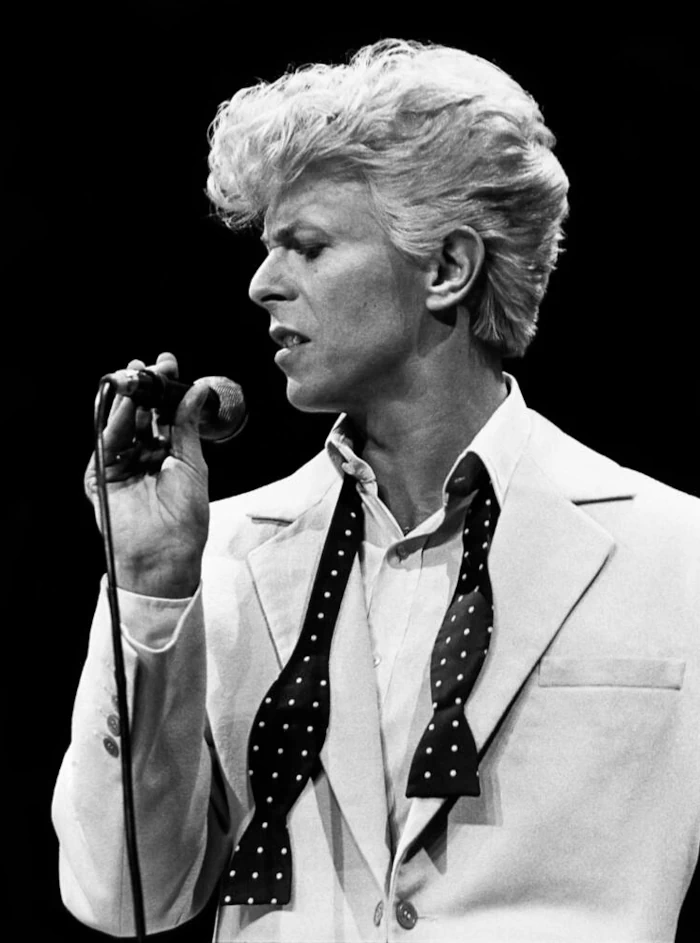
Global Pop and Legacy
Let’s Dance (1983), produced by Nile Rodgers with Stevie Ray Vaughan on guitar, propelled him to the top of global charts. It became the most commercially successful album of his career. He co-wrote and performed “Under Pressure” with Queen in 1981, one of rock’s most iconic duets.
His final album, Blackstar, was released on January 8, 2016, his 69th birthday, just two days before his death from liver cancer, which he had kept private. The album, dark and experimental, is widely seen as a deliberate and deeply moving artistic farewell. David Bowie died on January 10, 2016 in New York.
He sold over 140 million albums and was inducted into the Rock and Roll Hall of Fame in 1996.
Signature Guitars
Bowie is associated with the early Supro Dual Tone, as well as acoustic guitars from Takamine and Martin. His legendary guitarists include Mick Ronson (Ziggy era), Carlos Alomar, Robert Fripp, and Reeves Gabrels.


