Cat Stevens
Origins and Early Years
Steven Demetre Georgiou was born on July 21, 1948 in London, in the Soho district. Of Greek-Cypriot and Swedish descent, he grew up above his parents’ restaurant. He adopted the stage name Cat Stevens and achieved his first successes in 1966 with “I Love My Dog” and “Matthew and Son”, becoming a British teen idol at the age of 18.
The Folk Golden Age
After suffering from tuberculosis in 1968, which forced him into a year of recovery and led him into deep introspection, he returned transformed with landmark albums: Mona Bone Jakon (1970), Tea for the Tillerman (1970), and Teaser and the Firecat (1971). Songs such as “Wild World”, “Peace Train”, “Father and Son”, and “Morning Has Broken” became timeless classics.
His music, carried by a gentle voice and rare acoustic beauty, explores spiritual searching, human relationships, and the search for meaning. He sold over 60 million albums during this period and became one of the most respected songwriters in the world.
Conversion and Return
In 1977, after a near-drowning experience in the Pacific that deepened his faith, he converted to Islam and adopted the name Yusuf Islam. He left the music industry for nearly 25 years, dedicating himself to education and philanthropy, and founding Islamic schools in the United Kingdom.
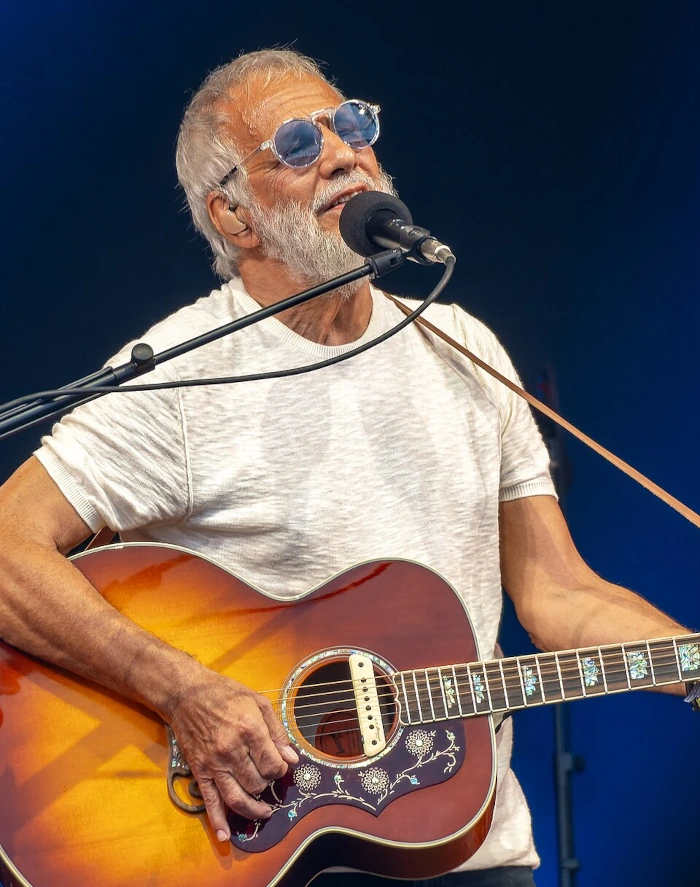
He returned to music in 2006 with the album An Other Cup and resumed worldwide touring under the name Yusuf / Cat Stevens. He was inducted into the Rock and Roll Hall of Fame in 2014.
Signature Guitar
Cat Stevens is associated with the Gibson J-160E (the same acoustic-electric guitar used by The Beatles) as well as various Guild and Martin acoustic guitars.


