
Bob Dylan
Origins and Early Years
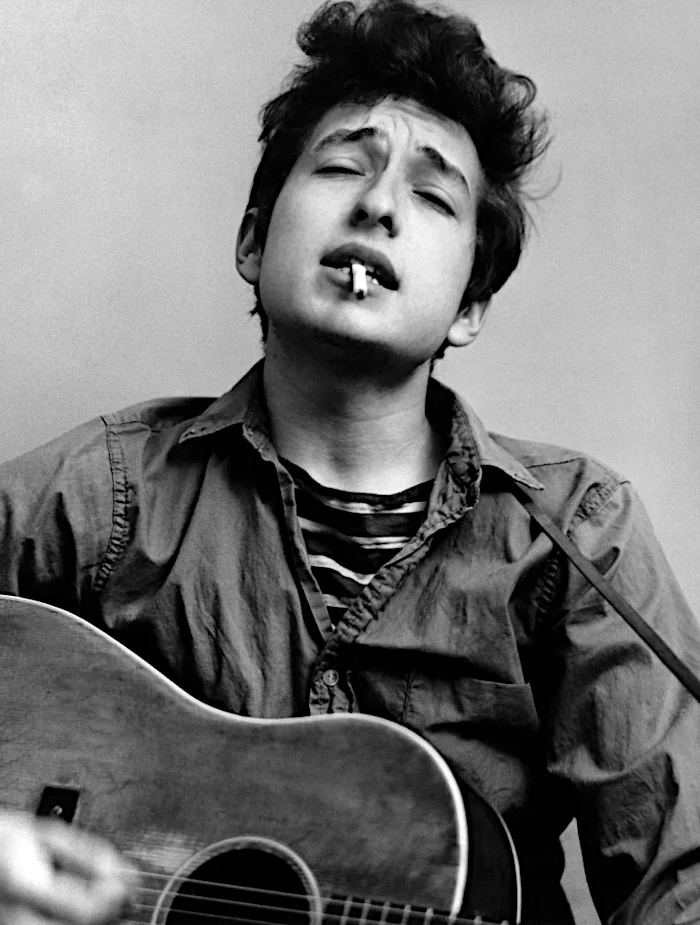
Robert Allen Zimmerman was born on May 24, 1941 in Duluth, Minnesota, and grew up in Hibbing, a mining town in the north. Passionate about Woody Guthrie, Robert Johnson, and the rock’n’roll of Little Richard, he moved to New York in 1961 and performed in the clubs of Greenwich Village.
He adopted the name Bob Dylan (possibly inspired by poet Dylan Thomas) and signed with Columbia Records thanks to legendary producer John Hammond.
Folk and Electric Icon
The Freewheelin’ Bob Dylan (1963) and songs like “Blowin’ in the Wind” and “The Times They Are a-Changin'” made him the spokesperson for the folk movement and the civil rights cause. He performed during the March on Washington led by Martin Luther King Jr. in August 1963.
In 1965, he electrified his music with Bringing It All Back Home and Highway 61 Revisited, causing controversy at the Newport Festival, where audience members booed him for plugging in his guitar. “Like a Rolling Stone” was considered by Rolling Stone Magazine to be the greatest song of all time. Blonde on Blonde (1966) became the first major double album in rock history.
Nobel Prize and Legacy
Bob Dylan received the Nobel Prize in Literature in 2016, becoming the first musician to be awarded the prize, “for having created new poetic expressions within the great American song tradition”. With over 125 million albums sold, he was inducted into the Rock and Roll Hall of Fame in 1988.
His career spans more than 60 years, marked by constant reinvention: folk, rock, country, gospel, and blues. The Never Ending Tour, which began in 1988, has totaled more than 3,000 concerts.
Iconic Guitars
Dylan is associated with the Martin 00-17 from his early folk years, the sunburst Fender Stratocaster used at Newport in 1965, and the acoustic Gibson J-45. His Newport Fender Stratocaster was sold at auction in 2013 for $965,000.


